
Most people abandon their monthly budget by week two. The numbers look fine on paper, but life happens fast. A surprise car repair, a few extra takeout orders, and suddenly you’re behind with three weeks left in the month. When you create a weekly spending plan instead, you shrink the window for mistakes. You get clear, fast feedback on your spending. And you can fix a bad week before it becomes a bad month. This guide walks you through every step, from calculating your income to tracking and adjusting your plan over time.
Table of Contents
- Key takeaways
- How to create a weekly spending plan from your income
- Building your spending envelopes and allocations
- Tracking, reviewing, and adjusting your plan
- Common pitfalls and how to avoid them
- My honest take on weekly budgeting
- Take control with the right tools
- FAQ
Key takeaways
| Point | Details |
|---|---|
| Use 4.33, not 4 | Divide monthly expenses by 4.33 to get accurate weekly figures, not a rounded estimate. |
| Treat savings as fixed | Automate savings and debt payments so they are never skipped or deprioritized. |
| Build in a buffer | Reserve a small weekly amount for unexpected costs to avoid blowing your entire plan. |
| Check in mid-week | A quick mid-week review lets you catch overspending before the week is gone. |
| Adjust regularly | Review your spending envelopes monthly and update them as your income or life changes. |
How to create a weekly spending plan from your income
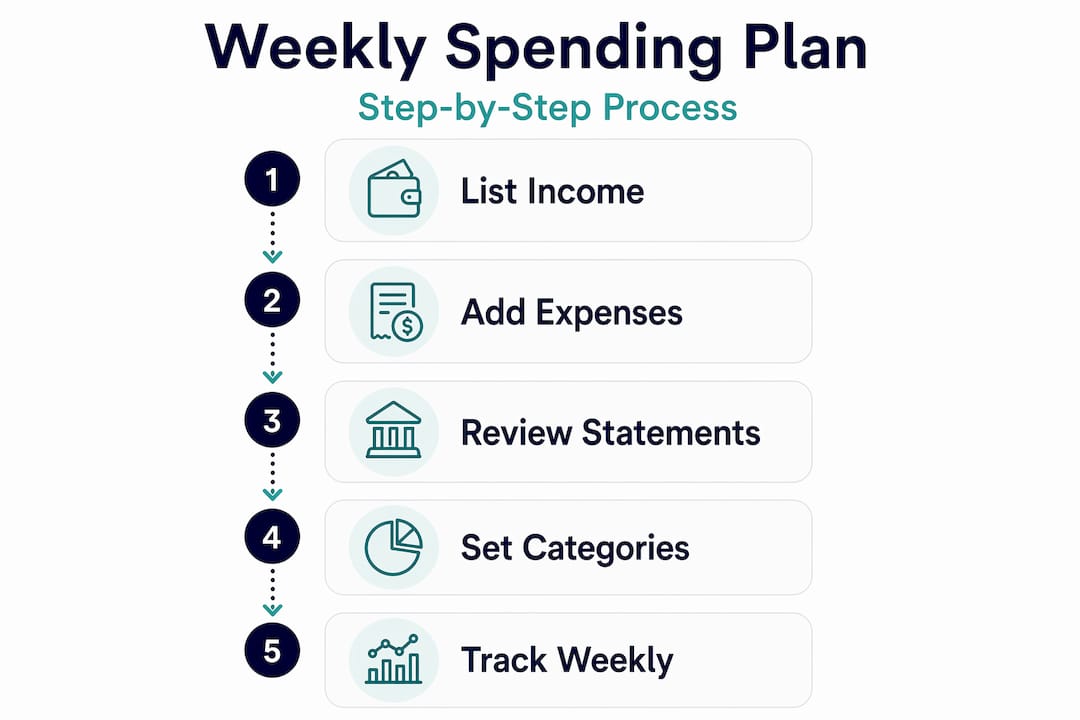
Before you allocate a single dollar, you need to know exactly how much money you actually have each week. This sounds obvious, but most people guess. And guessing leads to budgets that fall apart fast.
Start with your net income, meaning what lands in your bank account after taxes and deductions. If you get paid monthly, divide by 4.33 to get your true weekly figure. Using 4 instead of 4.33 inflates your weekly number slightly, which creates a small but consistent gap between your plan and reality. For example, $3,000 per month divided by 4.33 gives you roughly $693 per week, not $750.
Once you have your weekly income, sort your expenses into two groups:
- Fixed expenses: Rent, loan payments, subscriptions, insurance. These are predictable and do not change week to week.
- Variable expenses: Groceries, gas, dining out, entertainment. These shift based on your choices and habits.
Then there is a third category most people forget entirely. Irregular expenses like car registration, annual software subscriptions, or holiday gifts feel like surprises, but they are not. Divide annual costs by 52 to find their weekly equivalent and include that amount in your plan. A $520 car insurance bill becomes $10 per week. Small, manageable, and no longer a shock.
To get accurate numbers, review several weeks of bank statements and credit card transactions. Patterns will emerge quickly. You will likely find categories where you spend more than you think, and a few where you have room to cut.
Pro Tip: If your income varies week to week, base your weekly budget on your lowest consistent paycheck, not your average. Keep any extra income in a buffer account and draw from it during lean weeks.
Building your spending envelopes and allocations
Now you are ready to assign dollars to categories. Think of each category as a spending envelope. Once the envelope is empty, spending in that category stops for the week. This is the core mechanic that makes weekly expense management work.
Here is a step-by-step process to build your envelopes:
-
List every spending category. Start with fixed costs, then variable ones. Common categories include groceries, transportation, dining out, entertainment, personal care, clothing, and household supplies.
-
Set a realistic cap for each category. Base these on your actual spending history, not what you wish you spent. If you have been spending $120 per week on groceries, starting at $60 is a setup for failure. Reduce gradually instead.
-
Allocate savings and debt repayment first. Treat these as non-negotiable fixed costs and automate the transfers. Paying yourself first means savings never get squeezed out by discretionary spending. A practical framework from Fidelity suggests no more than 60% of take-home pay to essentials, 30% to lifestyle spending, and 10% to savings and near-term goals.
-
Add a buffer envelope. Allocate $15 to $30 per week specifically for unexpected small costs. This is not a slush fund for extras. It is a financial cushion for the things you genuinely could not predict.
-
Check that your total allocations do not exceed your weekly income. If they do, identify which variable categories to trim. Do not cut savings or fixed costs first.
-
Revisit your envelopes monthly. Life changes. A new gym membership, a pay raise, or a change in commute all affect your numbers. Budgeting percentages are flexible starting points and should shift as your circumstances do.
One practical option for enforcing envelope limits is to load each category’s weekly amount onto a separate prepaid card or sub-account. Using separate accounts per category creates a physical boundary that makes overspending much harder to rationalize.
Pro Tip: Do not create too many envelopes. Five to eight categories is the sweet spot. More than that and tracking becomes a chore. Fewer than five and you lose visibility into where money actually goes.

Tracking, reviewing, and adjusting your plan
Creating the plan is only half the work. The other half is following through, and that requires a simple, consistent tracking habit.
A good weekly financial plan includes a place to record your starting balance, expected income, fixed bill amounts, variable spending by category, savings transfers, and a running total. A structured weekly money template helps you see all of this at a glance without having to do mental math every time you buy something.
Here is what a basic weekly tracking table looks like in practice:
| Category | Budget | Spent | Remaining |
|---|---|---|---|
| Groceries | $120 | $87 | $33 |
| Transportation | $60 | $45 | $15 |
| Dining out | $40 | $40 | $0 |
| Entertainment | $30 | $12 | $18 |
| Buffer | $25 | $10 | $15 |
Updating this table takes less than five minutes a day. The payoff is that you always know where you stand.
A few habits that make tracking stick:
- Do a mid-week check-in every Wednesday. Weekly budget cycles let you catch overspending early and make real-time adjustments before the week ends. If dining out is already at $35 of a $40 budget by Wednesday, you know to cook at home Thursday and Friday.
- Use conditional formatting in spreadsheets. Embedding budget limits with automatic variance calculations highlights problem categories in red before they become crises. You can also find top expense tracking apps that do this automatically.
- Reconcile at the end of each week. Compare what you planned to spend against what you actually spent. This weekly reconciliation is where real learning happens. Over time, your estimates get sharper and your plan gets more accurate.
- Build a rolling buffer account. Any unspent buffer money at the end of the week rolls into a small reserve. After a few months, this reserve can absorb larger unexpected costs without touching your main budget.
Common pitfalls and how to avoid them
Even a well-designed plan can go sideways. Knowing where things typically break down helps you stay on track.
-
Setting budgets based on hope, not history. This is the most common mistake. If your actual grocery spending has been $150 per week for the past two months, budgeting $80 will not change your behavior. It will just make you feel like you failed. Start with your real numbers and reduce by 5 to 10 percent over time.
-
Forgetting irregular bills. Annual subscriptions, quarterly insurance payments, and seasonal expenses catch people off guard every time. Build these into your weekly plan as small, consistent amounts so they never surprise you.
-
Skipping the weekly review. A budget you do not check is just a list of intentions. The review is where the plan becomes real. Missing even two weeks in a row can let spending drift significantly.
-
Overspending early in the week with no plan to recover. If you blow your dining out budget on Monday, you need a clear rule for what happens next. Without a recovery plan, most people just keep spending and tell themselves they will do better next week.
-
Making the plan too rigid. A budget that allows zero flexibility creates stress and leads to abandonment. Build in a small “no questions asked” amount each week for spontaneous spending. Even $10 to $20 of guilt-free money makes the whole system feel less punishing.
“Spending mistakes in a weekly budget only affect that week. Next Monday, you start fresh.” This reset quality is one of the most underrated advantages of weekly budgeting over monthly planning.
My honest take on weekly budgeting
I have seen a lot of budgeting systems come and go, and the weekly approach consistently outperforms monthly planning for one simple reason: the feedback loop is short. When you check in weekly, you are never more than a few days away from a reset. That psychological fresh start matters more than most financial advice acknowledges.
What I have also learned is that the plan itself matters less than the habit of reviewing it. I have watched people with imperfect budgets succeed because they checked in consistently. I have also seen people with beautifully designed spreadsheets fail because they only opened them once a month.
The other thing worth saying: do not wait until your finances are “ready” to start. Your first weekly plan will be inaccurate. That is expected and fine. The goal in week one is not precision. It is awareness. Once you know where your money actually goes, you can make real decisions about where you want it to go.
If your income is irregular, budget to your lowest consistent week and keep a buffer account for higher-earning periods. Budgeting to your lowest income and drawing from a buffer during lean weeks removes the anxiety of variable pay cycles entirely.
Automate whatever you can. Savings transfers, bill payments, even category tracking. The less your budget depends on willpower, the more likely it is to survive contact with real life.
— SaverStride
Take control with the right tools
Building a weekly spending plan by hand is a solid starting point, but the right app makes the whole process faster and more accurate.

Valapoint’s personal finance app gives you real-time expense tracking, category budgets, and AI-powered insights that surface spending patterns you might miss on your own. Instead of manually updating a spreadsheet, Vala categorizes your transactions automatically and shows you exactly where you stand against your weekly budget at any moment. You can also use Valapoint’s finance calculators and tools to set up weekly savings targets, model debt payoff timelines, and build a budget that fits your actual income. If you are ready to stop guessing and start tracking with confidence, Valapoint gives you everything you need in one place.
FAQ
How do I calculate my weekly budget from a monthly income?
Divide your monthly net income by 4.33 to get an accurate weekly figure. Using 4 instead overstates your weekly amount and leads to a consistent shortfall.
What categories should I include in a weekly spending plan?
Start with fixed costs like rent and loan payments, then add variable categories such as groceries, transportation, dining out, and entertainment. Include a small buffer for unexpected expenses.
How often should I review my weekly spending plan?
Do a quick check-in mid-week and a full reconciliation at the end of each week. Review and update your category allocations at least once a month.
What should I do if I overspend in a category mid-week?
Reduce spending in another flexible category for the rest of the week to compensate. If overspending happens repeatedly, adjust that category’s budget to reflect your actual habits.
Is a weekly budget better than a monthly budget?
Weekly budgets create shorter feedback loops, so mistakes are caught and corrected faster. Overspending in a weekly plan only affects that week rather than derailing an entire month.